Transformer Selection Guide
Transformers and Their Types
Use these three decisions to narrow a project to the right product family.
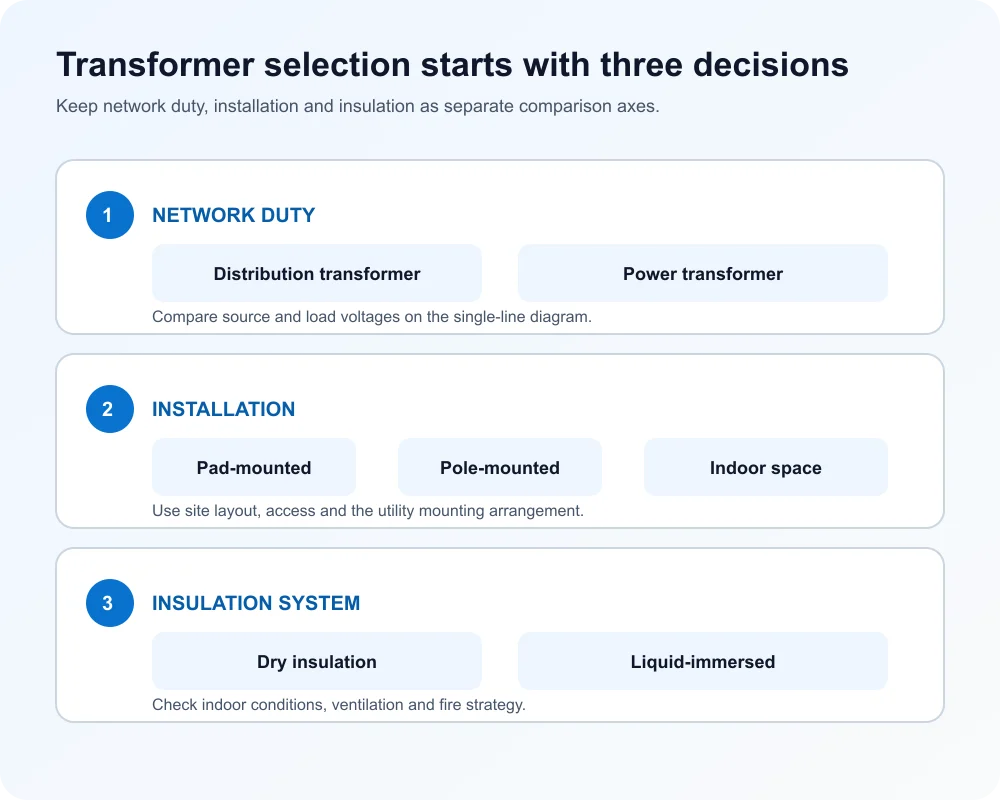
Transformer types can be grouped by network duty, installation method and insulation system. Use these three decisions to narrow a project to the right product family.
Start with network duty
A distribution transformer supplies downstream loads, while a power transformer serves a broader network transfer duty. Identify the source and load voltages on the single-line diagram before comparing construction. This keeps an installation choice, such as pad mounting, separate from an electrical duty.
Compare distribution transformer families for downstream supply and power transformers for higher-voltage network projects.
Compare location and insulation
An overhead network may lead to a pole-mounted design. Ground-level cable distribution may lead to a pad-mounted unit. Indoor space, ventilation and the fire strategy influence the choice between dry insulation and an insulating-liquid design.
Turn the shortlist into a specification
Record the phase arrangement, kVA, voltages, frequency, installation conditions and destination requirements. Send the same schedule with every enquiry. Use individual product pages for the dimensions and documentation of the shortlisted configuration.
| Item or condition | What to compare | Input or result |
|---|---|---|
| Network duty | Power or distribution | Source and load voltages |
| Installation | Pad, pole or indoor space | Site layout |
| Insulation | Dry or liquid-immersed | Environment and fire strategy |
Frequently Asked Questions
Is pad-mounted a separate electrical principle?
Pad mounting describes installation and enclosure arrangements. The winding connection and voltage duty are specified separately.
Where should capacity be selected?
Select capacity after the load and duty are defined, then check the chosen family against the project specification.
Compare transformer families for your project
Review the supply duty, installation and destination specification, then compare the relevant product family. For sizing support, start with the project load and operating conditions.