Transformer Fundamentals
kVA to Amps Calculator and Transformer Examples
Use the worked examples to compare transformer nameplate current and the current required by a balanced load.
Convert apparent power and current with the voltage and phase arrangement for the winding being assessed. The three-phase calculation assumes a balanced system and uses line-to-line voltage.
Transformer current calculator
Select a conversion, phase arrangement and voltage to calculate current or apparent power.
Formula: I = 1000 × kVA / V
Calculation estimate only. Use RMS values and make sure voltage and apparent power or current refer to the same transformer side. Confirm nameplate data, winding connection and project requirements.
Choose the electrical system
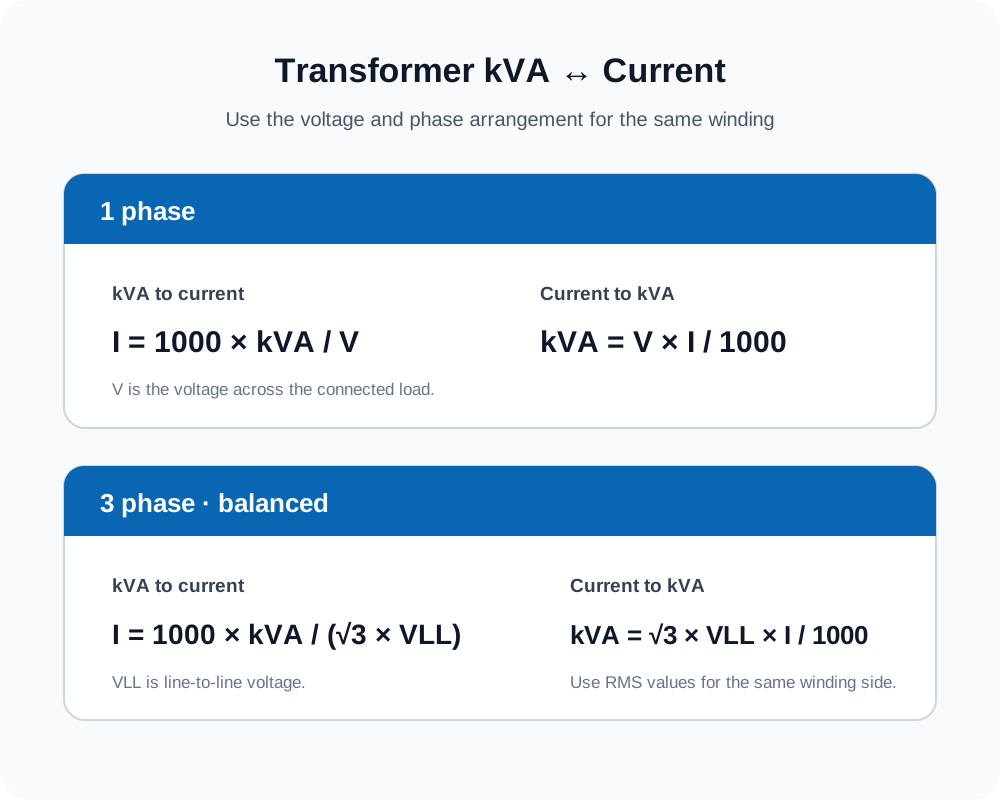
For single-phase AC, current in amperes is 1000 times kVA divided by voltage. For a balanced three-phase system, divide 1000 times kVA by the square root of three times line-to-line voltage. Use RMS values and select the side of the transformer being assessed.
For a short explanation of the equipment capacity unit used in this calculation, read what kVA means on a transformer rating.
| System | kVA to current | Current to kVA |
|---|---|---|
| 1 phase | I = 1000 × kVA / V | kVA = V × I / 1000 |
| 3 phase, balanced | I = 1000 × kVA / (√3 × VLL) | kVA = √3 × VLL × I / 1000 |
Check a three-phase example
For an illustrative 500 kVA transformer at 480 V, rated secondary current is 500000 divided by 1.732 times 480, or about 601 A. At 208 V, the same kVA corresponds to about 1388 A. These examples show why voltage belongs beside every current value.
| System | What to compare | Approximate result |
|---|---|---|
| 1 phase | 50 kVA at 240 V | 208 A |
| 3 phase, balanced | 500 kVA at 480 V line-to-line | 601 A |
| 3 phase, balanced | 500 kVA at 208 V line-to-line | 1388 A |
| Reverse conversion | 480 V line-to-line at 600 A | 498.8 kVA |
Convert current back to capacity
For balanced three-phase loads, kVA equals 1.732 times line-to-line voltage times current divided by 1000. Select the conversion direction, phase and voltage, then enter positive values. Record the selected transformer side beside the result.
Review how transformer voltage and current relate →Frequently asked questions
Is voltage line-to-line or line-to-neutral?
The three-phase formula on this page uses line-to-line voltage. The single-phase formula uses the voltage across the connected load.
Can this result choose a cable or breaker?
Use the result as a current input to the electrical design. Cable, breaker and protection selection also depends on installation conditions and applicable design rules.
Which side of a transformer should I calculate?
Use the voltage and kVA or current for the same winding side. Record whether the values refer to the primary or secondary and confirm them against the transformer nameplate and connection diagram.
Apply the calculation to a project
Use the calculated current with the nameplate, winding connection and project specification when reviewing a transformer configuration.