Transformer Fundamentals
Autotransformers and Two-Winding Transformers
Compare its connection, isolation characteristics and application inputs with a two-winding design.
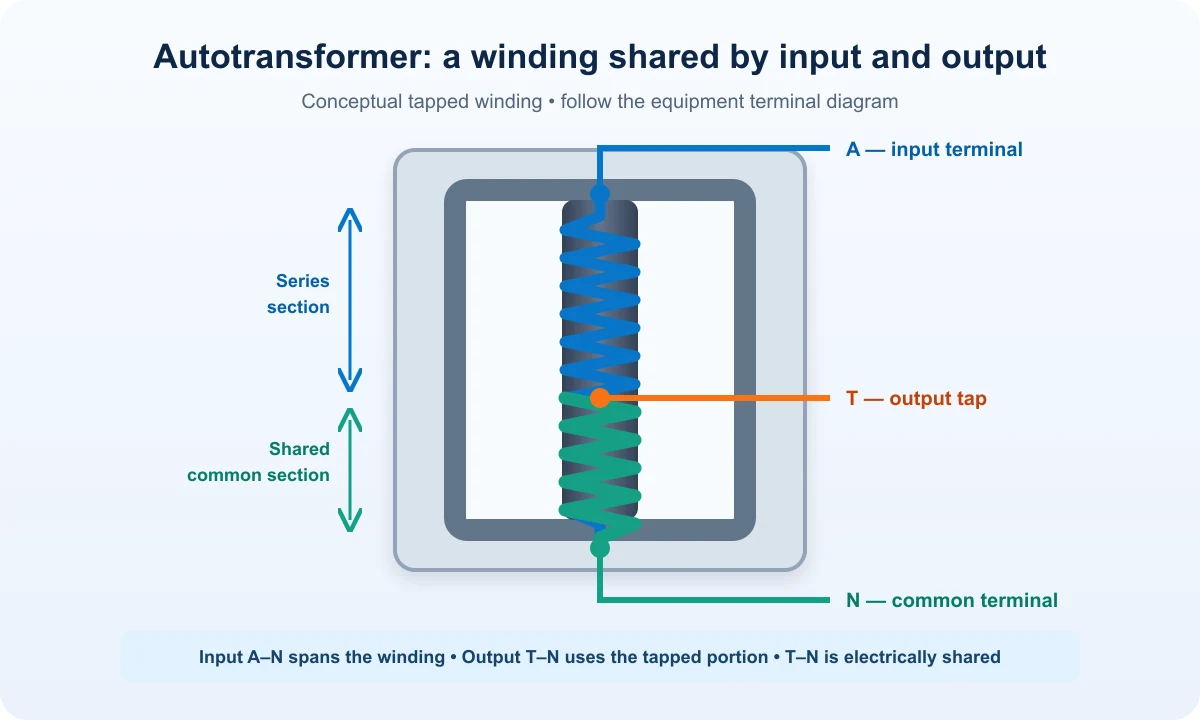
An autotransformer uses a shared winding section for voltage transformation. Compare its connection, isolation characteristics and application inputs with a two-winding design.
Understand the shared winding
Part of the winding belongs to both input and output circuits. This construction is different from the electrically separate windings of an isolation transformer. Follow the terminal diagram to identify the common portion and the voltage relationship.
Compare the system requirements
The choice depends on voltage ratio, grounding, insulation coordination and the application's need for electrical separation. Include available fault levels and protection requirements in the design review.
| Item or condition | What to compare | Input or result |
|---|---|---|
| Winding arrangement | Shared section | Review terminal diagram |
| Isolation requirement | Application-specific | State explicitly in RFQ |
| System coordination | Faults and grounding | Electrical design review |
Prepare a clear enquiry
State both system voltages, required capacity, frequency, phase and whether galvanic isolation is required. Ask the technical team to review an appropriate configuration against the actual source and load conditions.
Dry-type transformer options
Explore two-winding product families and confirm insulation and installation needs.
Pad-mounted transformer options
Review distribution options against the required system voltages and site conditions.
Buck boost voltage correction
Compare a modest voltage correction with a full step-up or step-down transformer duty.
Frequently Asked Questions
Does an autotransformer provide winding isolation?
Its input and output share an electrical winding connection. Use a separate-winding configuration when the application requires galvanic isolation.
Is it suitable for every voltage conversion?
Select construction from the voltage ratio, system requirements and isolation specification.
Submit technical requirements
Provide the input and output voltages, capacity, frequency, phase and isolation requirements for a configuration review.