Transformer Fundamentals
Buck Boost Transformers and Voltage Matching
Start with the actual source and load voltages, then review the manufacturer's connection chart and the full load current.
A buck boost transformer provides a small increase or decrease in supply voltage when connected for that duty. The selected connection depends on the source, target voltage and load current.
Separate voltage correction from load rating
The connected assembly can serve a load whose kVA differs from the transformer's two-winding nameplate rating. Selection depends on the voltage being added or subtracted and the current through that winding. Use the manufacturer's specific connection diagram and selection table for the proposed input and output.
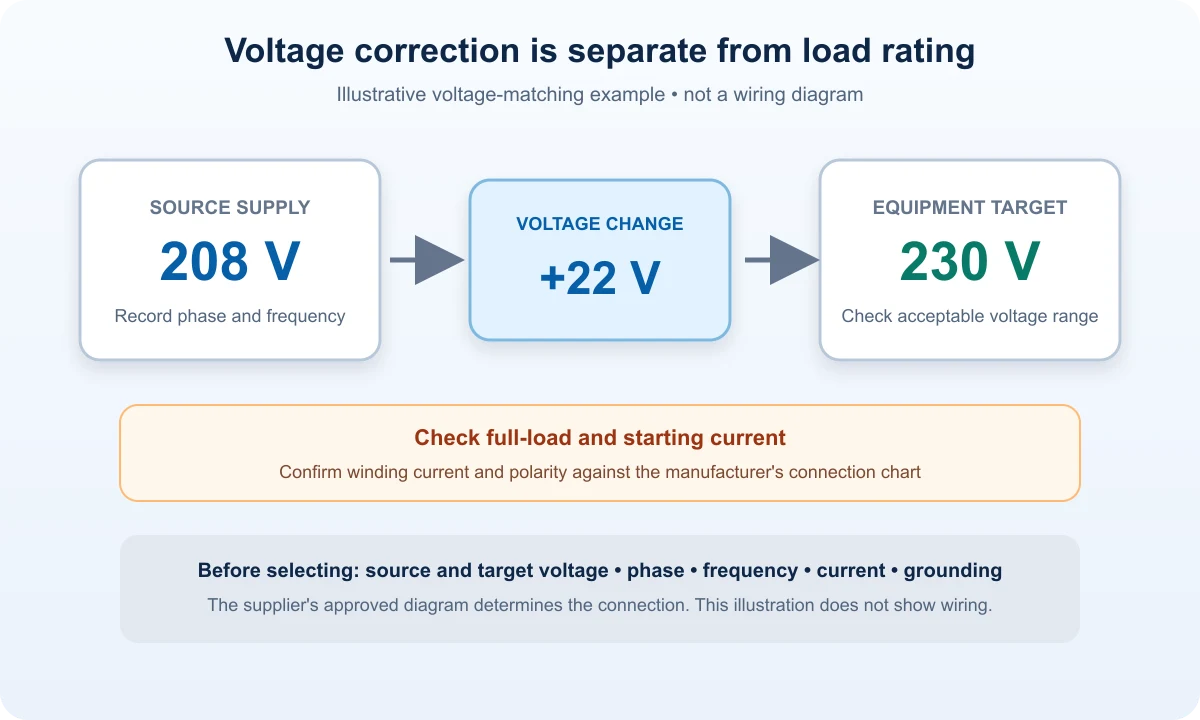
Compare a voltage-matching example
An illustrative 208 V supply may need adjustment for equipment specified for 230 V. The required change is 22 V. Record the equipment's acceptable voltage range and running and starting current before choosing a connection. Confirm phase arrangement, frequency and grounding with the designer.
| Item or condition | What to compare | Input or result |
|---|---|---|
| Buck connection | Subtracts a specified voltage | Confirm winding polarity |
| Boost connection | Adds a specified voltage | Confirm full load current |
| Selection documents | Input, output, phase and frequency | Manufacturer connection chart |
Choose the correct equipment route
For a modest voltage correction, ask the supplier for an approved buck boost selection. For a new distribution installation or a substantial voltage change, compare a purpose-designed step-down or step-up transformer. Keep electrical isolation requirements explicit in the enquiry.
Frequently Asked Questions
Does every buck boost connection provide isolation?
Common autotransformer connections share an electrical path. Specify a separate-winding design when the project requires galvanic isolation.
Can I select it using load kVA alone?
No. Provide source and target voltage, phase and full-load current so the supplier can select the winding and approved connection.
Discuss your project
Provide source and target voltage, phase, frequency, running and starting current, grounding and the required connection documentation.