Transformer Technical Guide
Ohm's Law and Its Use in Transformer Circuit Calculations
Solve a resistive example, check the units, and identify when AC impedance is required.
Ohm's law relates voltage, current and resistance through V = I × R for an ohmic element under the stated conditions. It is useful for understanding electrical quantities and resistance measurements. AC transformer circuits also involve reactance and require the appropriate impedance relationship.
Choose the formula and convert units
Use volts for V, amperes for I and ohms for R. Select the relationship for the quantity you need, then enter values in consistent units.
| Known quantities | Required quantity | Relationship for the resistive example |
|---|---|---|
| Voltage and resistance | Current | I = V / R |
| Current and resistance | Voltage | V = I × R |
| Voltage and current | Resistance | R = V / I |
| Current and resistance | Power | P = I²R |
| Voltage and resistance | Power | P = V² / R |
Convert units before calculation. A 500 mA current is 0.5 A, and 20 milliohms is 0.020 ohm. In an illustrative resistance measurement, 0.5 A through 0.020 ohm produces a 0.010 V drop, or 10 mV. Lead and contact resistance become important at small resistance values, so retain the specified measurement method with the result.
Calculate current and verify the result
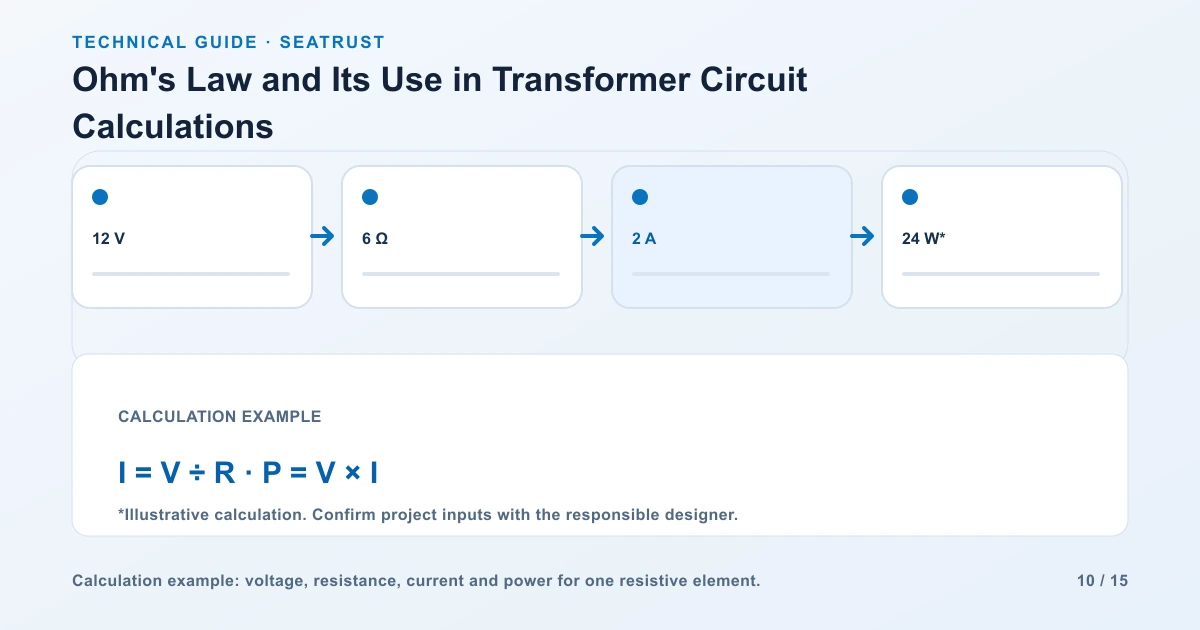
For a resistive calculation example, apply 12 V across a 6-ohm resistor. Calculate current first, then power.
| Quantity | Value or calculation |
|---|---|
| Voltage | 12 V |
| Resistance | 6 ohms |
| Current | 12 / 6 = 2 A |
| Power | 12 × 2 = 24 W |
Check the power with I²R: 2² × 6 = 24 W, matching V × I. Both methods use the same resistive model and units.
For AC circuits with inductance or capacitance, move to the impedance formula examples. There, current magnitude and phase follow the complex impedance rather than resistance alone.
Distinguish winding resistance from AC impedance
A winding resistance measurement concerns its resistive property under specified test conditions, including temperature. AC impedance includes the effect of reactance as well as resistance. Use the measurement and equivalent-circuit quantities required by the particular transformer calculation.
Record temperature and test conditions
When reviewing test reports, retain the measured winding or connection, instrument and relevant conditions. Resistance changes with conductor temperature, so comparisons need the stated reference conditions and correction method. Have the responsible engineer interpret the results against the equipment and test specification.
FAQ
Can winding DC resistance replace transformer percentage impedance?
Use each quantity for its intended calculation. DC resistance and percentage impedance represent different electrical measurements.
What should accompany a resistance reading?
Record the test object, units, instrument, temperature and applicable test procedure.
Specify the test information needed
Include required test reports and acceptance criteria with the transformer enquiry.