Power Quality Fundamentals
Total Harmonic Distortion in Transformer Loads
Record voltage THD and current THD separately when evaluating nonlinear loads supplied by a transformer.
Total harmonic distortion, or THD, compares harmonic components with the fundamental component of a waveform. Record voltage THD and current THD separately when evaluating nonlinear loads supplied by a transformer.
Identify the measured quantity
THD is the root-sum-square of the included harmonic magnitudes divided by the fundamental magnitude. State the measured quantity, harmonic range, instrument method and operating interval. The denominator distinguishes THD from metrics that use a demand-current reference.
Current THD (THDi)
√(Σ harmonic current²) ÷ fundamental current
Use current harmonic magnitudes and the fundamental current.
Voltage THD (THDv)
√(Σ harmonic voltage²) ÷ fundamental voltage
Measure voltage distortion separately; current values cannot determine it.
Read a current example
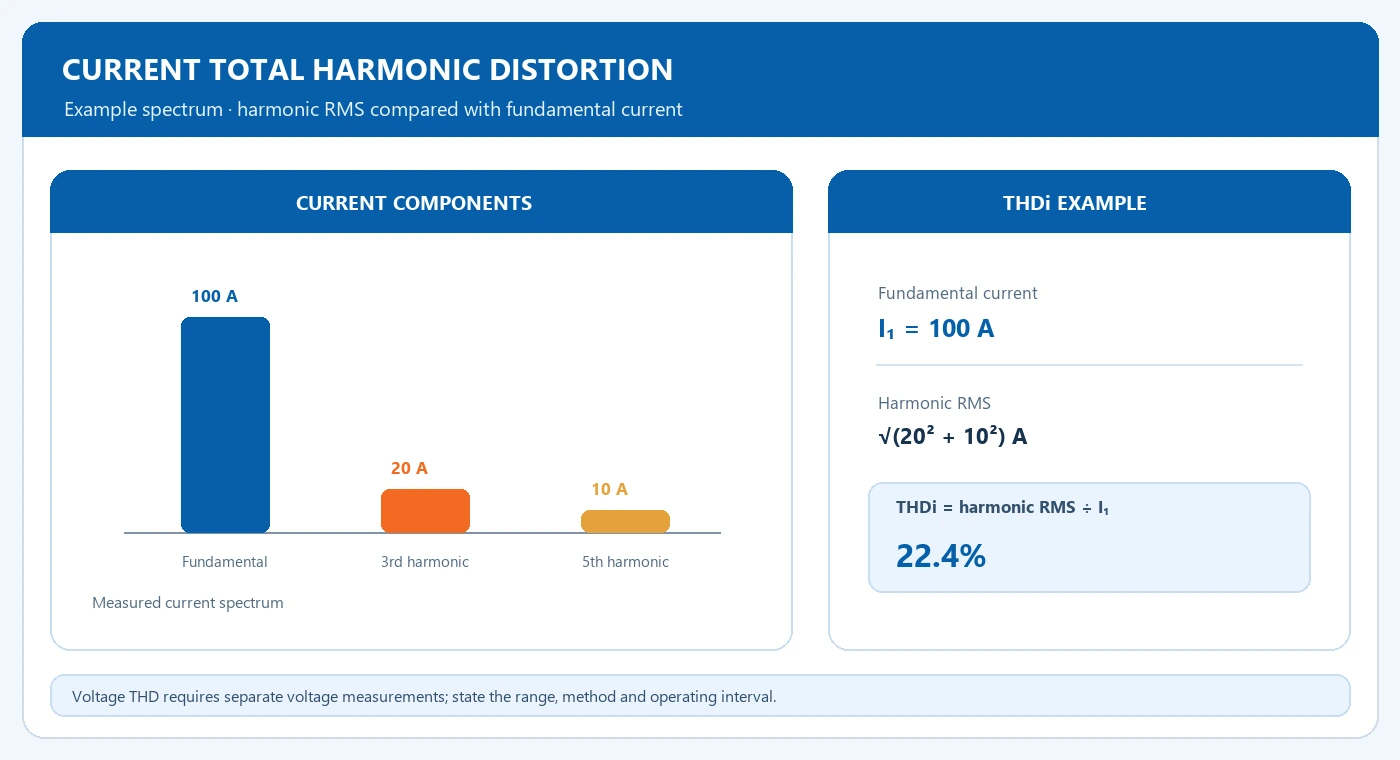
Suppose the fundamental current is 100 A, the third harmonic is 20 A and the fifth harmonic is 10 A, with other harmonics taken as zero in this example. Current THD is sqrt(20 squared + 10 squared) / 100, or 22.4%. Voltage distortion requires its own voltage measurements.
| Item or condition | What to compare | Input or result |
|---|---|---|
| Fundamental current | 100 A | Example reference |
| Third and fifth harmonics | 20 A and 10 A | Other harmonics zero in example |
| Calculated current THD | 22.4% | Voltage THD measured separately |
Example — current total harmonic distortion
THDi = √(20² + 10²) ÷ 100 = 22.4%
Fundamental current: 100 A · third harmonic: 20 A · fifth harmonic: 10 A · other harmonics: zero in this example.
Prepare the transformer assessment
Collect the harmonic spectrum, RMS current, phase balance and neutral current where applicable. Nonlinear loads can affect winding heating and system interaction. Review transformer duty and any compensation equipment using the measured operating profile.
Measurement record
Record quantity, harmonic range, instrument method, operating interval and representative load state.
Transformer context
Include phase balance, neutral current where applicable, RMS current and compensation equipment.
Frequently Asked Questions
Does a THD percentage identify the largest harmonic?
Use the spectrum to identify individual harmonic orders and magnitudes.
When should measurements be taken?
Record representative load states, including heavy operation and switching events relevant to the project.
Plan a power-quality review
Share voltage and current harmonic spectra separately with operating state, RMS current, phase balance and any compensation equipment.