Transformer Fundamentals
Three Phase Power Explained
This arrangement supports power distribution and industrial loads with a consistent set of line voltage, line current and capacity ratings.
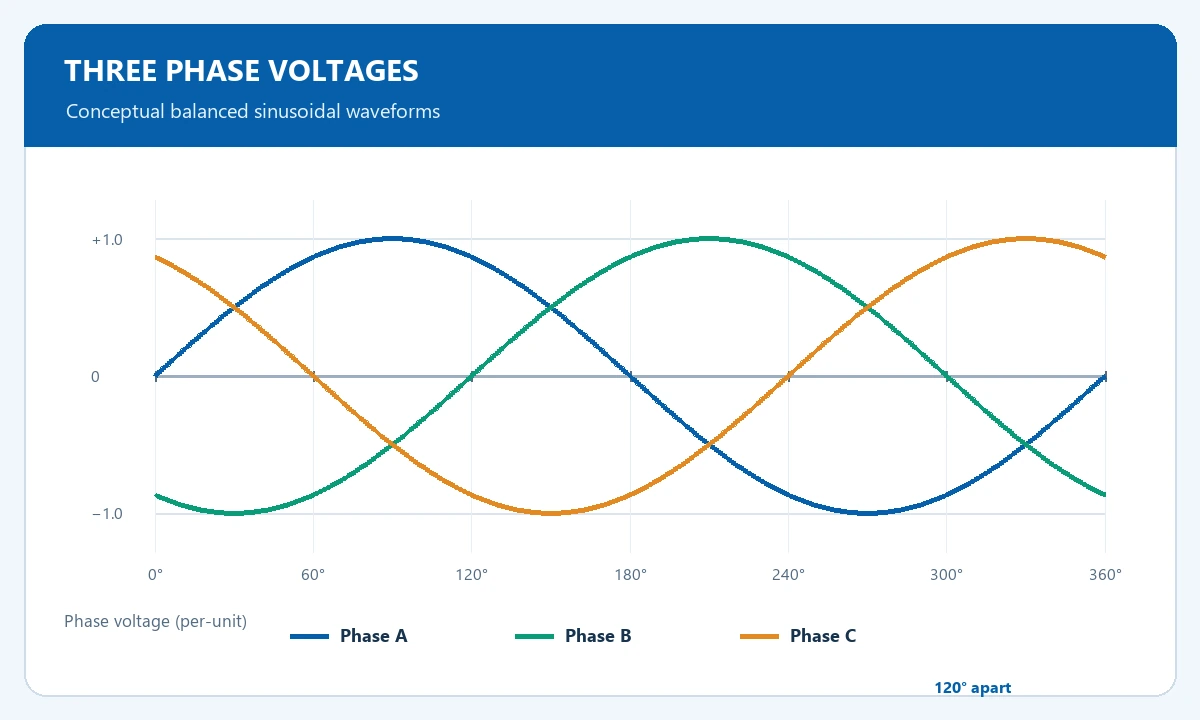
Three-phase power uses three alternating phase voltages separated by 120 degrees. This arrangement supports power distribution and industrial loads with a consistent set of line voltage, line current and capacity ratings.
Follow the three waveforms
In a balanced system, the phase voltages have the same magnitude and frequency with equal displacement. Balanced sinusoidal loads produce constant total instantaneous power. Real sites also include uneven single-phase loads and nonlinear equipment, so phase balance belongs in the operating review.
Calculate on a line basis
For balanced three-phase AC, apparent power in kVA equals √3 × line-to-line voltage × line current / 1000. At 480 V and 100 A, apparent power is 83.1 kVA. At 0.90 power factor, active power is 74.8 kW. Keep the same line-to-line voltage basis throughout the calculation.
Balanced three-phase power
S = √3 × VLL × IL / 1000
P = S × PF
Example: √3 × 480 V × 100 A / 1000 = 83.1 kVA; 83.1 kVA × 0.90 = 74.8 kW. These balanced-load formulas use line-to-line voltage and line current.
| Item or condition | What to compare | Input or result |
|---|---|---|
| Phase displacement | 120 degrees | Balanced three-phase system |
| 480 V and 100 A | 83.1 kVA | Line quantities |
| Power factor 0.90 | 74.8 kW | Active power |
For current calculations from active power, enter electrical input kW, line-to-line voltage and power factor in the kW to amps calculator.
Document the equipment interfaces
List supply voltage, frequency, three-phase load current and any neutral requirement. Show transformer connections and downstream distribution on the single-line diagram. Check phase sequence and instrument scaling during the approved commissioning process.
Connect supply and load quantities to transformer configuration.
Compare supply arrangements for a site and its equipment.
Review Three-Phase Pad-Mounted TransformersExplore a distribution transformer family for three-phase networks.
Review Three-Phase Pole-Mounted TransformersReview the three-phase pole-mounted transformer range.
Frequently Asked Questions
Does every three-phase circuit use a neutral?
Neutral requirements follow the transformer winding connection and the connected loads.
Where should I compare single and three phase?
Use the linked supply comparison for service and equipment selection; this page explains three-phase quantities.
Review three-phase power for your application
Share the supply voltage, frequency, line current, phase balance, neutral requirement and transformer connection for an engineering review.