Transformer Engineering Blog
How to Prepare for a Power Outage at an Electrical Facility
Turn a power outage response into a tested load, communication and restoration plan.
To prepare for a power outage, identify what depends on electricity, decide what must keep working, check alternative power and communications, and write down who acts when supply is lost. For a facility, the plan also needs an approved electrical operating arrangement and a controlled restart sequence.
Start with the people, equipment and processes affected by an interruption. A reliable plan connects a load list with named responsibilities, usable records and tested equipment.
Open the preparation checklist
Classify loads by the consequence of interruption
Create a list of loads at the level the operations team can act on: equipment ID, location, purpose, demand, permitted interruption and restart conditions. Record the normal source and any approved backup source.
| Load group | Question to resolve | Record to keep |
|---|---|---|
| Life-safety and required services | Which functions have specific continuity requirements? | Approved design and maintenance records |
| Critical process | What is lost or damaged when the process stops? | Shutdown requirements and recovery priority |
| Controlled shutdown | How much time is needed to stop safely? | Required support duration and operator steps |
| Deferrable load | Can the load remain off while supply is restored? | Restart permission and priority |
Use the actual site requirements to assign each load. Put process cooling, access systems and communications on the list as well as production machinery. A small auxiliary load can determine whether a larger process can shut down safely.
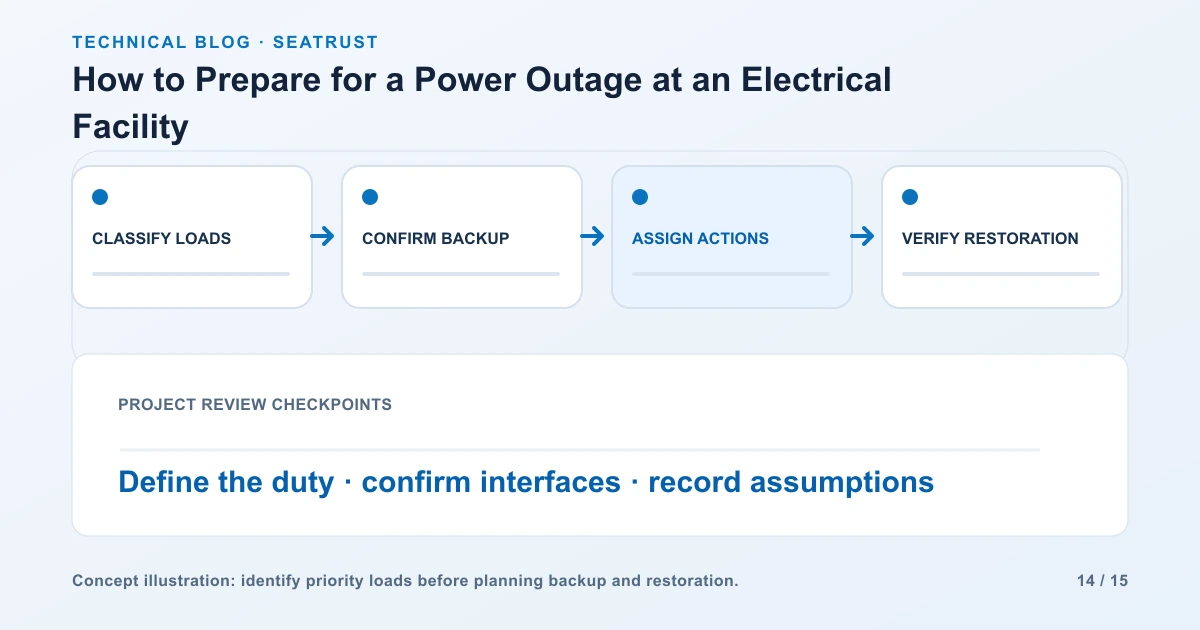
Complete the pre-event checklist
| Item | Action before the event | Evidence of completion |
|---|---|---|
| Drawings and labels | Confirm the approved single-line diagram and equipment IDs | Current revision available to authorized staff |
| Contact list | Record utility, electrical service, operations and emergency contacts | Accessible online and offline copy |
| Critical-load list | Confirm load priorities and interruption limits | Signed load schedule |
| Backup equipment | Review inspection, test and maintenance records | Open defects assigned and resolved |
| Communications | Check radios, phones and charging arrangements | Tested contact route |
| Lighting and access | Check emergency lighting and safe access arrangements | Inspection record |
| Process shutdown | Assign decisions and steps to trained personnel | Procedure and exercise record |
| Restart plan | Define permission, sequence and verification | Approved restoration checklist |
For general household and personnel preparedness, Ready.gov's power-outage guidance recommends an inventory of electricity-dependent items, alternative power arrangements and plans for important needs. Apply those personal preparations alongside the facility's engineering and operating procedures.
Match backup support to a specific task
State what the backup arrangement must accomplish: bridge a short interruption, support a controlled shutdown or maintain a selected load group. Record both power demand and duration.
For an illustrative calculation, a 2 kW communications load running for 30 minutes needs 1 kWh delivered to the load: 2 kW × 0.5 h. Selecting a battery or UPS additionally requires its usable capacity, efficiency, operating temperature, ageing allowance and runtime curve at the actual load.
| Backup requirement | Information to verify |
|---|---|
| Running load | Measured or specified kW, kVA and power factor |
| Starting or step load | Largest load change and its sequence |
| Support duration | Required operating or shutdown time |
| Transfer behavior | Permitted interruption and actual transfer arrangement |
| Energy or fuel | Usable reserve and replenishment responsibility |
| Maintenance | Test result, defects and readiness status |
Keep the transformer, transfer equipment and backup source ratings coordinated. The transformer selection guide identifies the load and supply information needed for the transformer portion.
Plan safe temporary power
Portable generators belong outdoors, with exhaust kept away from building openings. Ready.gov specifies at least 20 feet from windows, doors and attached garages, and advises keeping generators dry and letting them cool before refueling.
Connection to building wiring must use the approved transfer arrangement installed by qualified personnel. Avoid improvised backfeeding. Assign operation, inspection and fuel handling to trained people and follow the equipment instructions and site procedure.
Keep one event record
When supply is interrupted, the operations lead confirms the affected area and starts a time-stamped log. The authorized electrical team investigates supply and protection indications under the site procedure. Other staff use the agreed communications channel and process-shutdown actions.
| Event field | What to enter |
|---|---|
| Time and location | Start time, building/area and equipment IDs |
| Observed condition | Loss of supply, alarm or abnormal equipment behavior |
| Running loads | Process state immediately before the event |
| Indications | Available protection, control and backup status records |
| Actions | Action, responsible person and time |
| External reference | Utility incident or service request |
| Restoration | Permission, sequence, verification and remaining restrictions |
For event classification, use the brownout and blackout comparison. Keep the original records so later investigation can distinguish the initial failure from subsequent equipment responses.
Restore supply in an agreed sequence
Restoration begins after the authorized team confirms that the equipment and supply conditions permit it. Follow the approved switching and process sequence. Restore priority loads first, verify their operation, then progress through the remaining groups.
Check for equipment that reset, retained an alarm or requires a manual process restart. Record the final load state and outstanding defects. If the event involved the transformer, retain relevant nameplate data, protection records, temperature trends and inspection findings for technical review.
Review the plan after a test or outage
Use a short review with actions, owners and due dates. Focus on specific failures: an inaccessible drawing, an uncharged radio, a load that exceeded available backup capacity, a failed transfer or an unclear restart permission.
Exercise the updated plan through the site's approved maintenance and emergency program. A completed review should leave the next team with clearer responsibilities and corrected equipment or records.
FAQ
Where should outage planning start?
Begin with electricity-dependent functions and the consequence of losing them. Use that list to set load priority, backup needs and shutdown actions.
What is the difference between kW and runtime?
kW describes power demand. Runtime also depends on usable stored energy or fuel, equipment performance and operating conditions.
Which loads should restart first?
Use the site's approved priority list and electrical/process restart sequence. Account for starting currents and dependent systems.
What should be recorded after a test?
Record the actual sequence, transfer results, unsupported loads, alarms, runtime observations and corrective actions.
Review the transformer continuity duty
For a transformer replacement or new supply arrangement, send the critical-load schedule, normal and outage diagrams, supply voltages and site conditions.