Transformer Technical Guide
Brownout vs Blackout and What to Record at Your Site
Identify the event, record its effect on equipment, and plan a controlled response.
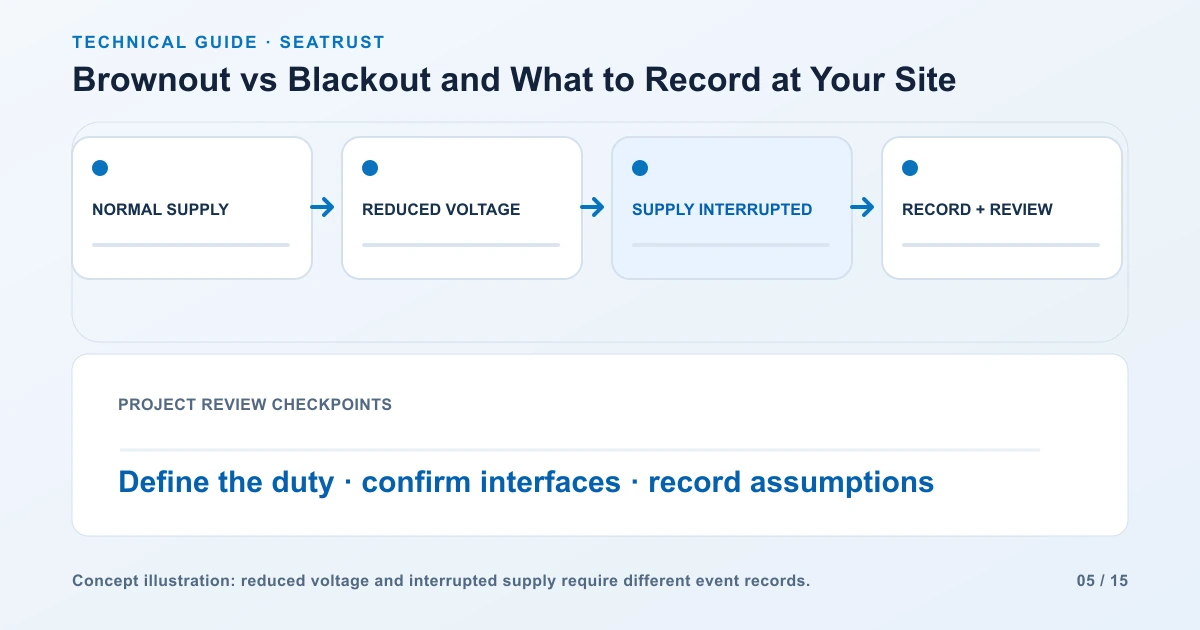
A brownout is a reduction in supply voltage while power remains available. A blackout is a loss of electrical supply. Both can interrupt work, but they leave different evidence. For a facility team, the useful first step is to record the timing, affected equipment and available monitoring data so the utility and electrical team can investigate the event.
Identify the difference
During a brownout, connected equipment may receive a lower voltage than expected. Lights may dim, controls may reset and some motors may run abnormally or stop. During a blackout, the affected circuit or site loses its normal supply. A working backup source may keep selected loads operating, so record which supply was feeding each affected load. Use the comparison table to describe what was observed.
| Observation | Brownout | Blackout |
|---|---|---|
| Supply condition | Reduced voltage with supply still present | Loss of normal supply in the affected area |
| Possible site signs | Dimming, resets, trips or abnormal equipment operation | Stopped equipment and loss of normal lighting |
| Important record | Measured voltage, duration and equipment behavior | Outage duration, affected circuits and backup response |
| Utility question | Was a voltage disturbance recorded at this time? | Was an interruption recorded and what restoration information is available? |
| Equipment review | Input-voltage range and undervoltage response | Backup duty, transfer sequence and controlled restart |
Separate the observation from the cause
A voltage event can originate in the utility network or within a facility. Record whether the disturbance affected one machine, one distribution area or the entire site. Check the utility's published incident information and pass the event details to the responsible electrical team. Dimming alone gives an observation; time-aligned voltage and equipment records give the investigation a clearer starting point.
Follow the site's response procedure
Keep people away from damaged, smoking or arcing equipment and activate the site's emergency response when those signs appear. Authorized personnel should handle electrical isolation and inspection. For an ordinary low-voltage event, follow the approved procedure for affected machinery and sensitive equipment. Keep records of trips, interrupted processes and backup operation. Restart equipment through the agreed recovery sequence after the responsible team confirms the supply and equipment condition.
Record the event and identify the review path
Record the start and end times, affected areas, equipment identifiers and operator observations. Add existing alarm logs and voltage-monitoring exports where available, with their measurement locations and units. Include the normal supply rating and the recorded event values as separate fields. Keep the original files with the event record so the investigator can check timestamps and compare the sequence across systems.
| Field | Information to enter |
|---|---|
| Event time | Start, end, time zone and monitoring-system clock reference |
| Affected area | Building, feeder and equipment identifiers |
| Observed behavior | Dimming, reset, trip, stopped process or backup operation |
| Voltage record | Normal rating, event reading, units and measurement point |
| Evidence | Alarm export, existing monitoring file and authorized photographs |
| Recovery | Actions taken, restart authorization and outstanding faults |
| Observation | What to record | Review path |
|---|---|---|
| Supply remains present but equipment behaves abnormally | Voltage trend, affected circuits, load state | Supply quality and equipment tolerance review |
| Complete interruption | Duration, affected area, breaker and utility status | Supply-loss investigation and continuity plan |
| Repeated motor restart | Starting sequence, voltage during restart, protection operation | Motor and system coordination review |
| Event follows a site load change | New load, operating time, current trend | Updated load and voltage study |
Use the power outage preparation checklist to assign responsibilities before the next interruption. Restoration decisions belong to the site's authorized electrical team.
Review protection and transformer requirements
Ask the electrical designer to review the equipment's allowed input range and response to undervoltage or interruption. A UPS assessment needs the actual load, voltage range and required runtime. A surge-protection assessment addresses transient overvoltage. Backup supply, transfer and restart arrangements need their own approved design. Set out the disturbance to be addressed and the critical loads before choosing equipment.
Provide the transformer ratings, connection, tap arrangement, load profile and event records for the system review. The responsible engineer can compare the supply at the transformer and at the affected load, then identify the required corrective work. If that review calls for a transformer change, carry the approved voltage, capacity, regulation and installation requirements into the procurement brief. Keep the investigation records linked to the final specification.
FAQ
Can a brownout damage equipment?
Sustained low voltage can damage some motors and electronics. Check the affected equipment's specified input range and follow its service instructions after a suspected voltage event.
Does a surge protector solve a brownout?
Surge protection addresses voltage spikes. Ask the electrical designer to select the protection or backup arrangement for the actual undervoltage and interruption duty.
Does a brownout mean the transformer must be replaced?
Use the supply records, load measurements and equipment inspection to establish the cause. Specify a transformer replacement when the system assessment identifies that corrective action.
Prepare the transformer requirements after the supply review
Send the approved ratings, load profile and installation requirements when your project includes a transformer replacement or upgrade.