Transformer Technical Guide
Electrical Switchyard Equipment and Transformer Interfaces
Coordinate electrical connections, terminal positions and site access across the same drawing set.
An electrical switchyard connects and switches power circuits using equipment arranged for the network's operating requirements. Bus arrangements, switching duties and protection determine how circuits connect. Where a transformer interfaces with the yard, both electrical and physical connection details must align.
Read the bus arrangement
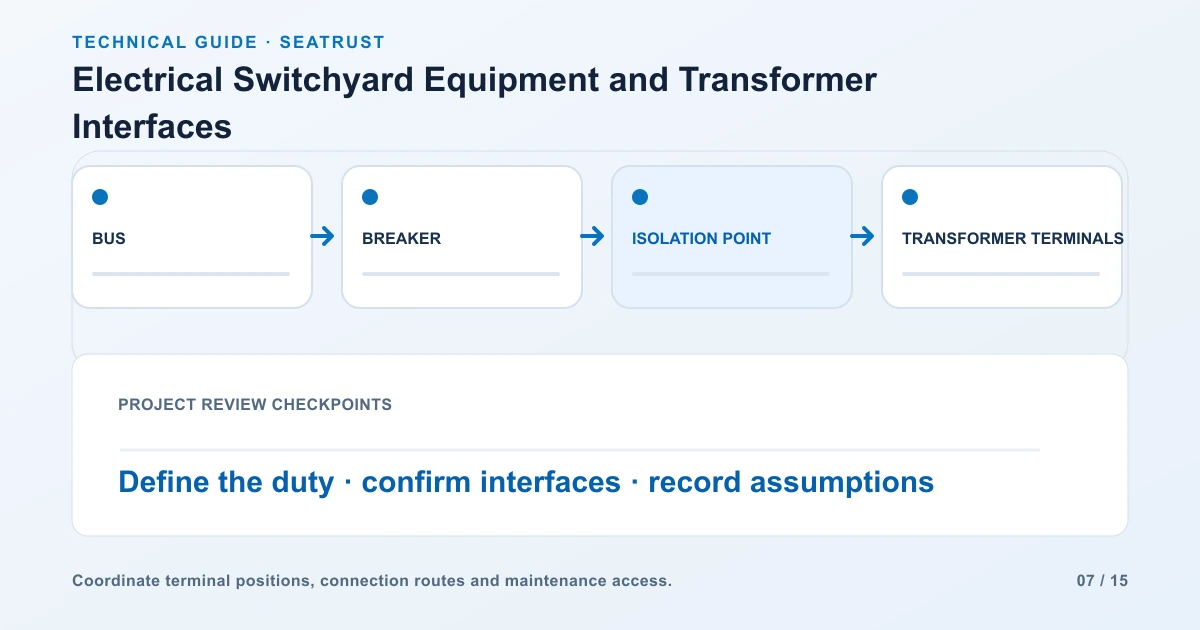
Start with the approved single-line diagram and identify which circuits connect to each bus section. Record how the network is intended to operate during normal service and planned outages. The arrangement affects the specification of switching and protection equipment as well as the transformer connections.
| Arrangement question | Information needed | Decision owner |
|---|---|---|
| One source or multiple sources? | Utility supply and operating requirements | Network designer |
| Which equipment can be isolated for maintenance? | Approved switching and outage arrangement | Operations and protection team |
| How is a future transformer bay accommodated? | Expansion duty, reserved space and connections | Project design team |
| What reaches the manufacturer's terminals? | Interface drawings and scope schedule | Purchaser and equipment suppliers |
Use transmission-line interface requirements when the transformer bay receives power from an incoming line.
Define the transformer connection
Record the nominal system voltage, equipment voltage class, winding connections and connection method. Identify the bushing or cable interface and the required terminal arrangement. Include the phase identification and the information needed for protection and metering.
Coordinate the physical layout
Use the site layout to show equipment positions, connection routes, foundations and access for delivery and maintenance. The responsible project designers establish clearances, grounding and other site requirements from the applicable project standards. Carry those requirements into the equipment data sheets and layout drawings.
Control the drawing interfaces
Keep one reviewed set of electrical, civil and equipment drawings. When a terminal position, bus elevation or equipment dimension changes, check its effect on adjacent connections and access. Agree which drawing revision is used for manufacture, installation and site acceptance.
Verify the switchyard interface register
Follow the transformer bay through four documents: the single-line diagram, equipment data sheet, terminal drawing and site layout. Mark the same equipment ID on all four. Check the electrical connection before comparing physical dimensions.
| Interface | Evidence and information | Acceptance check |
|---|---|---|
| Electrical connection | Single-line diagram, winding connection, voltage, current, insulation and fault duties | Do the voltage, phase, neutral and equipment duties agree? |
| Transformer terminals | Bushing or cable termination drawing, mating parts, orientation and phase labels | Do connection types, positions and phase identification agree? |
| Civil and physical fit | General arrangement, foundation drawing, loads, anchor positions and cable routes | Are foundations, loads, dimensions and connections coordinated? |
| Maintenance | Site access, delivery and handling plan | Can the unit be delivered, inspected and replaced? |
| Protection and control | Approved signal schedule, protection inputs and operating scheme | Are contacts, measurements and control responsibilities assigned? |
| Document control | Approved drawings, revision and responsible party | Does each discipline use the agreed drawing revision? |
For example, moving a transformer terminal from one side to another can change buswork length, cable routing and maintenance access. Treat that change as a drawing revision affecting several disciplines, and close each affected item before manufacturing release.
FAQ
How is a switchyard related to a substation?
A switchyard provides switching and circuit connections and may form part of a wider substation installation.
Which drawing should be reviewed first?
Review the approved single-line diagram together with the equipment layout and transformer terminal drawings.
Coordinate the transformer connection
Send the station diagram, terminal arrangement and site requirements with the requested transformer ratings.