Distribution Networks and Transformer Roles
Electrical Energy Distribution and Transformer Roles
Transformers change voltage at defined points, while switching, protection and conductors connect the network to its customers.
Electrical energy distribution delivers power from supply substations to homes, businesses and industrial loads. Transformers change voltage at defined points, while switching, protection and conductors connect the network to its customers.
Follow the voltage stages
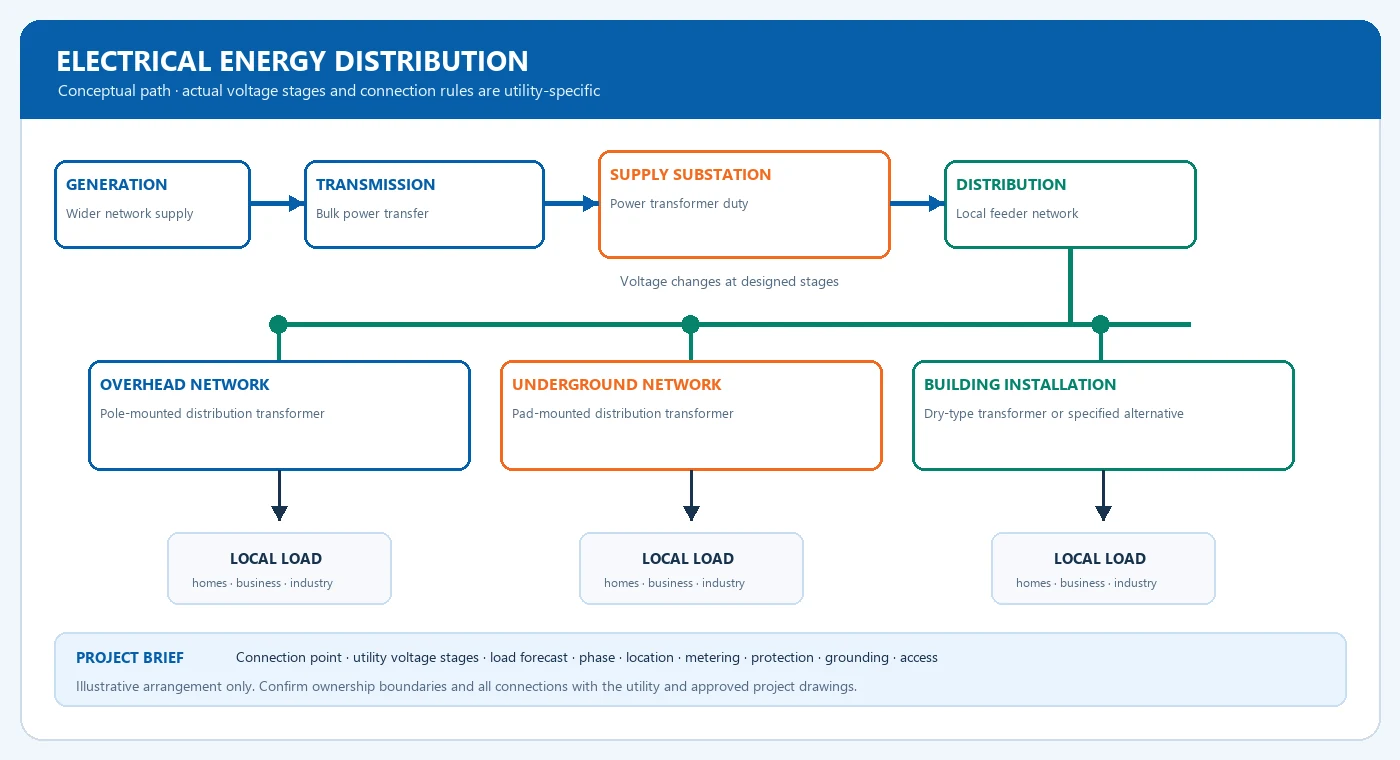
Generation supplies the wider network, transmission moves bulk power, and distribution brings it toward local users. Substation transformers and local distribution transformers perform different duties within that chain. Use the utility's actual voltage levels and connection rules for the project.
Compare overhead and underground arrangements
Overhead networks may use pole-mounted distribution equipment. Underground cable networks may use pad-mounted units, while a building installation may call for dry-type construction. Access, environment, cable entry and ownership boundaries influence the equipment arrangement.
| Item or condition | What to compare | Input or result |
|---|---|---|
| Bulk network | High-voltage transfer | Power transformer duty |
| Local distribution | Overhead or underground supply | Pole-mounted or pad-mounted |
| Facility interface | Building load and site conditions | Dry-type or specified alternative |
Build the supply brief
Record the connection point, available supply, load forecast, phase requirement and installation location. Add metering, protection, grounding and maintenance-access requirements. Share the single-line diagram and utility conditions with the transformer supplier before requesting a configuration.
Supply conditions
Document connection point, utility voltage stages, phase and utility connection rules.
Load and site
Provide the load forecast, installation location, environment and access needs.
System interfaces
Coordinate metering, protection, grounding, ownership and maintenance requirements.
Frequently Asked Questions
Where does distribution end?
The utility and customer documents define ownership, metering and responsibility at the service interface.
Which transformer family fits a new project?
Match the supply voltage, load, installation and utility requirements to the product family's documented capabilities.
Prepare a distribution transformer brief
Share the network diagram, utility conditions, supply stages, load forecast, installation arrangement and system interface requirements.