Transformer Technical Guide
Alternating Current and Transformer Frequency
Keep voltage, frequency, waveform and phase information together when specifying AC equipment.
Alternating current changes direction with time. AC power systems are described using frequency, voltage, phase arrangement and other operating quantities. A transformer's rated voltage and frequency work together in defining its intended operating conditions.
Read the frequency
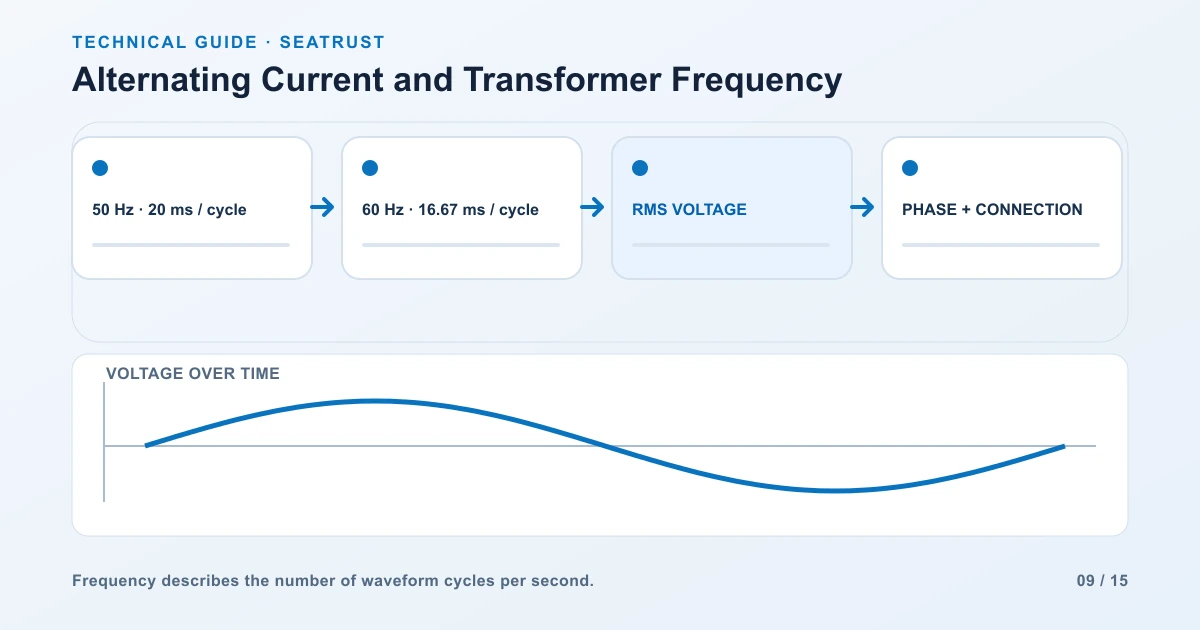
Frequency in hertz describes cycles per second. A 60 Hz waveform completes 60 cycles each second; a 50 Hz waveform completes 50. State the actual system frequency in the equipment specification and check the equipment's listed ratings.
Read RMS, peak and waveform records
For a sine wave, Vpeak = Vrms × √2. Keep RMS, peak and peak-to-peak values clearly labeled in calculations and records.
Record whether a voltage is RMS, peak or peak-to-peak. A 120 V RMS sine wave has a peak near 169.7 V and a peak-to-peak value near 339.4 V. RMS-to-peak conversion depends on waveform shape, so retain harmonic and distortion information when it matters to the load.
The sinusoidal waveform reading guide walks through the time axis, period, peak and RMS values using one calculated example.
Review voltage and frequency together
Transformer magnetic operation depends on the applied voltage and frequency as well as the design. A proposed change of frequency needs a manufacturer review against the required voltage, loading and thermal duty. Specify the intended operating conditions before selecting equipment.
Consider a transformer rated 480 V at 60 Hz. Its rated voltage-to-frequency ratio is 8 V/Hz. Applying 480 V at 50 Hz gives 9.6 V/Hz, a 20% increase. In a sinusoidal transformer model with unchanged turns and core area, flux is proportional to V/f, so this change requires a magnetic and thermal review.
Reducing the voltage to 400 V at 50 Hz restores the same 8 V/Hz ratio. Capacity, cooling, losses and the offered rating still need to be confirmed for that operating condition. Include the proposed voltage and frequency together in the enquiry.
| Supply record | Example | Review question |
|---|---|---|
| Rated supply | 480 V, 60 Hz | What does the equipment nameplate permit? |
| Proposed supply | 480 V, 50 Hz | How does the increased V/f affect the design? |
| Alternative duty | 400 V, 50 Hz | What loading and cooling rating applies? |
Prepare the AC supply and load record
State whether the supply is single-phase or three-phase and identify the winding connections. Loads with substantial harmonics may require additional information and study. Provide the load characteristics and power-quality requirements as part of the project brief.
| Field | What to state |
|---|---|
| Voltage | Nominal and operating range, with RMS and line convention |
| Frequency | System hertz and permitted operating range |
| Phase | Single-phase or three-phase arrangement |
| Connections | Required winding connections and system grounding |
| Load | Demand, load profile and relevant harmonic information |
FAQ
What does 60 Hz mean?
The waveform completes 60 cycles per second.
Can a transformer be moved between frequency systems?
Send the proposed voltage, frequency and duty to the manufacturer for a rating review before use.
Confirm the supply conditions
Include voltage, frequency, phase and load characteristics with the requested transformer capacity.