Transformer Losses
Joule Heating and Transformer Winding Losses
In transformer windings and external connections, the current and resistance determine an important part of the loss and thermal duty.
Joule heating is the conversion of electrical energy into heat as current flows through resistance. In transformer windings and external connections, the current and resistance determine an important part of the loss and thermal duty.
Use the resistance at the relevant condition
For a resistive element, power loss is I squared times R. Use RMS current for the corresponding AC resistance model. Resistance changes with material and temperature, while winding AC losses may also include frequency-dependent effects.
Resistive power loss
P = I² × R
For AC operation, use the RMS current with the resistance model that matches the operating condition. In a real winding, resistance and additional AC effects may depend on temperature and frequency.
Compare two operating points
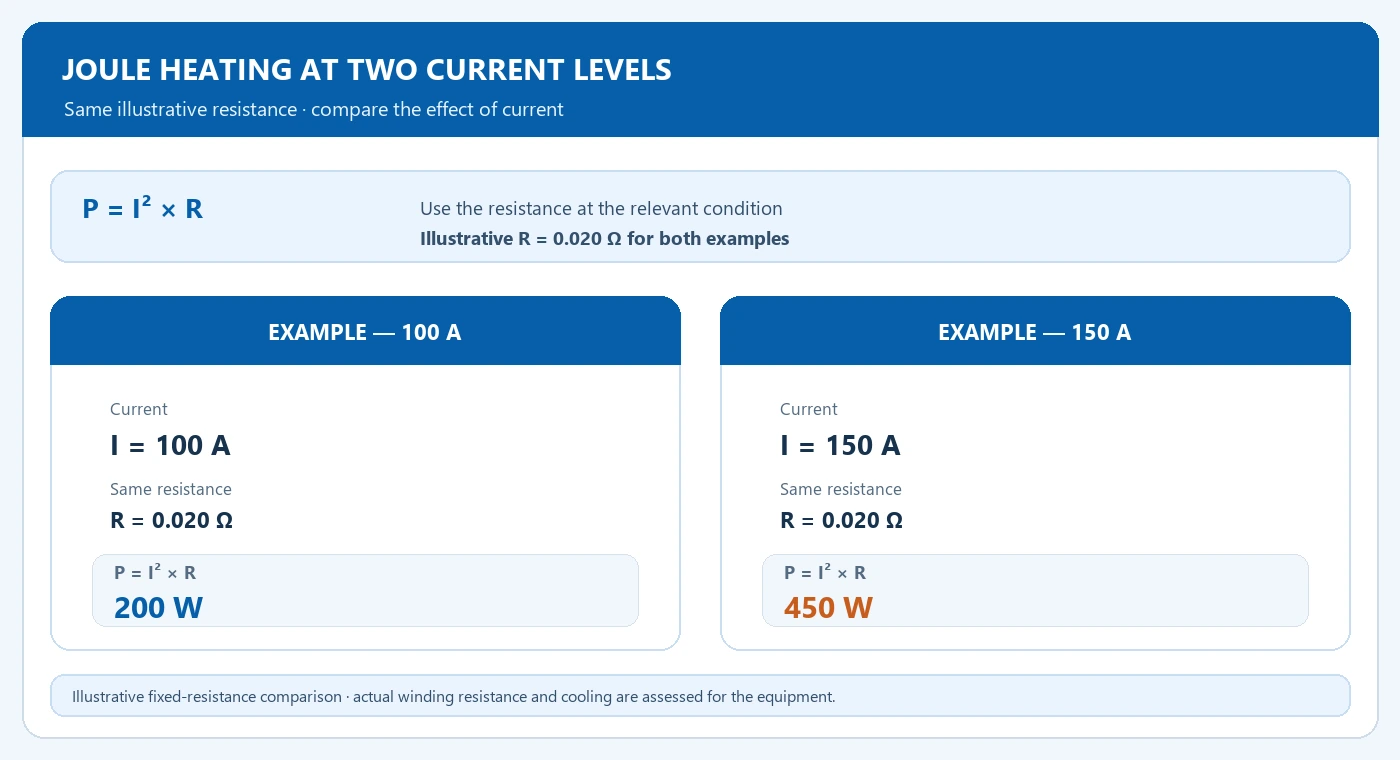
With an illustrative 0.020 ohm resistance, 100 A produces 200 W of resistive loss. At 150 A, the same resistance produces 450 W. The example isolates the current effect; actual operating resistance and cooling conditions are evaluated in the equipment's thermal design.
| Item or condition | What to compare | Input or result |
|---|---|---|
| Illustrative resistance | 0.020 ohm | Same value in both examples |
| 100 A example | 100² × 0.020 | 200 W |
| 150 A example | 150² × 0.020 | 450 W |
Example — 100 A
100² × 0.020 = 200 W
Example — 150 A
150² × 0.020 = 450 W
Connect losses to inspection and selection
Compare quoted transformer losses at the same reference conditions. For installed equipment, qualified personnel assess abnormal temperature against load, environment and connection condition. Keep measured current, ambient conditions and inspection records together.
Winding and connection losses
Current through winding and connection resistance contributes to load-related heating.
Core losses
Core losses are separate from this simplified I²R example. Use manufacturer test data for equipment comparisons.
Frequently Asked Questions
Why does current have a strong effect on heating?
With resistance held constant, loss increases with the square of current.
Is all transformer loss winding resistance loss?
The full loss includes core and other load-related effects. Use the manufacturer's test data for equipment comparison.
Review transformer loss and temperature data
Compare losses at matching reference conditions and record load current, ambient conditions and inspection findings together.